Guided Reading and Literacy Centers Middle School
 By Katherine McKnight
Every center school teacher faces the same challenge: embrace a huge corporeality of content, support literacy development, gear up students for important evaluations, and accommodate the social demands of adolescence – all while somehow managing to meet every student'south unique needs.
When I hear publishers and production developers merits that they have a one-size-fits-all, effortless style to improve educatee learning, well, let'due south just say I'm circumspect.
I know how hard it is, I know how hard teachers work, and I know the solution can't be purchased.
My xxx-plus years of classroom experience confirm my belief that effective teaching and learning is grounded in the relationship between teacher and pupil. Classroom innovations come up and become, but that relationship is the one affair that always remains constant.
That'south why, for the past half-dozen years, I've worked with teachers in schools all over the state to develop and fine tune a Literacy & Learning Eye (LLC) model for grades 4–12.
When almost teachers think of centers, nosotros identify them with the Yard-3 classroom. But when the model is expanded and adjusted for heart grades students, it incorporates many of the essential elements that successful middle level schools strive for:
- balanced literacy,
- content cognition acquisition,
- kinesthetic learning,
- differentiated instruction,
- formative assessment, and
- response to intervention.
All that, and the LLC model doesn't require teachers or schools to buy anything!
The Advantages of LLC for Kids and Teachers
As I implemented the Literacy & Learning Heart model in endless schools, the tangible advantages became clear. The combination of cocky-directed activities and brusk, specific tasks lent itself to the natural strengths of center school students.
Quite simply, they tended to exist more than engaged in their learning when they worked in centers. During cocky-reflection, the students often reported that it was easier for them to focus and they felt more empowered to ask questions.

Teachers who use the model written report that even their most reluctant learners don't complain of being bored. On the opposite, students merits that time passes apace as they collaborate with peers, learn content, and reinforce skill evolution. Teachers concord that discipline problems fade away as the self-directed activities provide the independence the students crave – with the guidance they demand.
Perhaps the most astounding matter of all, teachers discovered that the LLC model enabled them to cover more than content in less time. And in special instructor-led centers, they had an opportunity to provide personalized instruction and private formative assessment of each student.
On average, the schools in which Literacy & Learning Centers were implemented effectively saw student achievement on national assessments (such equally PARCC and NAEP) rising betwixt 13-xviii% in ane bookish twelvemonth. This is a staggering statistic and the success tin can exist attributed to the fact that centre school students larn better when they are doing rather than just passively accepting instruction.
Central Pedagogical Research-based Philosophies Grounding the LLC Model
Balanced Literacy – Substantial literacy research has established the importance of integrating reading, writing, speaking, listening, vocabulary, and linguistic communication in a synergetic instructional approach. In this model, students are provided with aplenty opportunities to develop their literacy skills in multiple contexts—through integration, not isolation.
 Formative Assessment – When teachers have meaningful feedback from, and insight into, their students, they are able to adjust instruction to ensure that their students are developing skills
and content knowledge. This is usually achieved through conferencing with students and providing on-the-spot descriptive and supportive feedback. In the LLC model, students take the opportunity, through the teacher-led centre, to receive this kind of feedback on a regular basis.
Formative Assessment – When teachers have meaningful feedback from, and insight into, their students, they are able to adjust instruction to ensure that their students are developing skills
and content knowledge. This is usually achieved through conferencing with students and providing on-the-spot descriptive and supportive feedback. In the LLC model, students take the opportunity, through the teacher-led centre, to receive this kind of feedback on a regular basis.
Differentiated Instruction – We know that all of our students are not the same. Yet when teachers are faced with large classes, how tin can we provide individual instruction and choice equally the differentiated instructional model promotes? Through Literacy & Learning Centers, teachers can create learning activities that let for educatee pick, flexible group, and modification of skills.
Multi-Tiered Intervention – Every bit a central component for closing the student accomplishment gap, multi-tiered interventions are offered in response to student information or other classroom functioning data. When educators are able to target individual students and provide specific interventions to improve skill development, students are less probable to fall behind. In the LLC model these interventions tin be addressed in the instructor-led eye equally well equally in the individual centers.
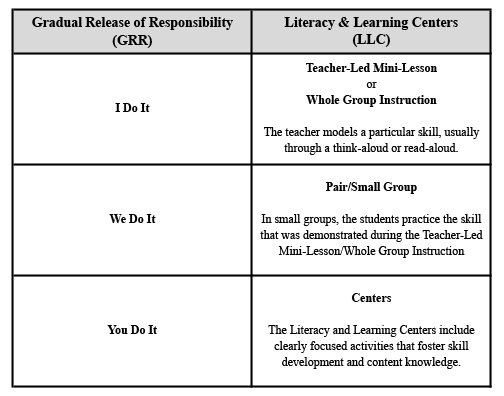
Gradual Release of Responsibility – The Literacy & Learning Center framework shifts the focus of learning onto the pupil, while the instructor provides modeling and guidance through structured activities. When Literacy & Learning Centers are aligned with the Gradual Release of Responsibility (GRR) model, students can piece of work toward developing a greater range of skills in order to increase more independent learning.
How the LLC Model Works Across Content
Although in that location are suggested structures for the model, it'due south important to retrieve that it is malleable. It tin easily be adapted for any content area, and in that location are ample opportunities to incorporate technology into the centers.
Footstep One: Teacher-Led Education – This is an opportunity for the teacher to begin the lesson with a whole-group mini- lesson that models a skill for students. In the GRR framework, this is the "I Practise It" component. In curt, the Literacy & Learning Center approach begins with teacher modeling. This modeling provides the foundation for the student practice ("Nosotros Do It") and the centre time ("You Do It") that will follow the teacher-led instruction.
Step Two: Student Practice – In the GRR framework, this is the "We Do It" component. During this time, the students work in pairs or modest groups to exercise the skill or discuss the content that was introduced by the teacher in Step One. The idea is for students to have ample practise time in order to develop skills and content knowledge. This is an integral gene for successful LLC implementation, and it is especially important in lite of Richard Allington's research (2012) about schools that are able to close the pupil achievement gap in literacy. Practice is critical.

Step 3: Eye Fourth dimension – This is an opportunity for pocket-size teams of 3–5 students to piece of work together in centers. No affair what your area of expertise is, I always recommend starting with what I call the 4 foundational centers: teacher-led center, vocabulary, writer'south craft and reading together. Depending on the content area, teachers tin can add together even more centers.
Each center consists of a clearly articulated activeness that promotes educatee independence, provides practice, and develops skills and content knowledge. In the GRR framework, heart time represents the "Y'all Do It" component. I advise teachers to kickoff small-scale, introducing a limited number of centers ane 24-hour interval a week. Then, as students get comfortable with the procedures and teachers get comfortable with their new role of facilitator rather than lecturer, they can add together more centers. The results volition be dramatic and positive.
Building a Collaborative Classroom Customs for All Students
The Literacy & Learning Center model is based on my work and experiences in classrooms, and it is built on enquiry that indicates the best practices for the development of literacy skills. Imagine class 4–8 students developing literacy skills and content knowledge in an engaged classroom setting, as function of a collaborative classroom customs. Isn't this what we want for all of our students?
Resources: Lesson Ideas for Literacy and Learning Centers
Note: Thanks to Katie McKnight for sharing these lesson resources from her upcoming book Literacy & Learning Centers: Engaging Learners Classroom Tools – Volume 1.
Snapchat the Primary Point – (download lesson)
- Description: Afterward reading a text together, students work in teams to summarize the writer's main point using nothing but a quick sketch and 80 or fewer characters.
- Skills: Students work together on reading goals (identifying a central idea, summarization, citing evidence), speaking & listening goals (chat, reasoning, citing show, presenting data), and writing goals (job/purpose/audition, production, planning, revising and editing).
- This activity tin be used in the following eye(s): Reading Together, Writer's Craft, Speaking & Listening, and Instructor-Led
-
Defragging Sentence Fragments – (download lesson)
- Description: In this activity, students match upwardly two sentence fragments to create one complete judgement about the form content.
- Skills: Students practice recognizing the difference betwixt sentence fragments and complete sentences. They then craft complete sentences to express articulate ideas virtually content.
- This activity can be used in the post-obit center(southward): Grammar and Author's Craft
Lexicographer: or Write Your Own Dictionary – (download lesson)
- Description: A lexicographer is someone who writes lexicon definitions. In this activity, students gather their own list of unfamiliar or unusual words during contained reading and, at the vocabulary centre, enter them into their own personal dictionaries.
- Skills: When they keep a personal record of newly acquired vocabulary words, students learn vocabulary as an aspect of cocky-directed and self-regulated learning. They practice using context clues and reference materials to decide word meanings, and they explore the relationship between word forms.
- This activeness can be used in the following center(south): Vocabulary
Teacher Tip: Start Small and Grow –
- Description: The centers model works in so many contexts! I advise teachers to kickoff pocket-sized, adding a limited number of centers i or 2 days a week. And then, as students go comfy with the procedures and teachers get comfy with their new part as facilitator, add together more.
- Linked content: Watch this nifty video (and download this guide). It's the Literacy & Learning Eye model in action in East St. Louis, IL.
 Dr. Katherine McKnight is an honor-winning author, professional development consultant, CEO and founder of Engaging Learners, LLC, keynote speaker, champion of the inclusive classroom, and passionate literacy advocate. She served as a Distinguished Professor of Research at National Louis University. With Deanna Gallagher she offers the podcast Two Lit(eracy) Ladies. She frequents Chiliad-12 classrooms all over the earth. Her latest book is Literacy and Learning Centers for the Big Kids: Building Literacy Skills and Content Cognition, Grades iv-12 (2017). Also run into Katie McKnight'due south folio of costless resource at MyEdExperts.
Source: https://www.middleweb.com/38283/literacy-learning-centers-for-the-big-kids/
0 Response to "Guided Reading and Literacy Centers Middle School"
Post a Comment